Getting legally married in New Jersey takes a license from a local Registrar of Vital Statistics, a ceremony led by someone the law allows, and a certificate filed afterward. This guide summarizes the state's official brochure for couples from the Department of Health and what town registrars tell couples. New Jersey licenses are issued by municipalities, and each registrar sets its own hours and appointment rules, so call yours early.
The short version
- Who issues it: the local registrar in the New Jersey municipality where either of you lives. If neither of you lives in New Jersey, the registrar in the town where the ceremony will be.
- Bring a witness: an adult (18 or older) must come with you to the application.
- Waiting period: the license is issued no sooner than 72 hours after you apply.
- Validity: the application is good for six months; the license, once issued, for 30 days.
- Fee: $28 everywhere in the state.
- Age: both of you must be 18. New Jersey does not allow anyone younger to marry.
- Officiant: a judge, a mayor or authorized deputy mayor, a county clerk or surrogate, a township committee chair or village president, or a minister of any religion.
- After the ceremony: the officiant files the license and certificate with the registrar of the town where the ceremony took place.
Which town to apply in
If either of you lives in New Jersey, apply to the registrar in that person's municipality. The license is then good anywhere in the state, so a couple from Hoboken can marry in Cape May. If neither of you lives in New Jersey, you must apply in the town where the ceremony will happen, and the license is good only in that town. That matters for destination weddings at the Shore: a venue's mailing address and its municipality are not always the same, so confirm which town the venue is actually in before you apply. A New Jersey license can never be used in another state, and another state's license cannot be used here.
What to bring
Both of you complete the application in front of the registrar. Each of you brings photo ID (a driver's license, passport or state or federal ID), proof of residency, and your Social Security number. You also bring one witness who is at least 18, and the $28 fee; many registrars take only cash, check or money order and see couples by appointment only. If either of you was married before, ask what proof the registrar needs.
The 72-hour wait and the 30-day window
The registrar cannot issue the license until 72 hours after you apply, unless a Superior Court judge orders it. Because registrars rarely work weekends, the state advises applying no later than the Tuesday before a Saturday or Sunday wedding. Once the license is issued, you have 30 days to use it, so most couples apply two to four weeks before the wedding. If you plan both a civil and a religious ceremony, one application can cover both.
Who can perform the ceremony
Under N.J.S.A. 37:1-13, a New Jersey ceremony can be performed by federal judges and magistrates, municipal, Superior Court and Tax Court judges (including some retired judges), a county surrogate or county clerk, a mayor or a deputy mayor the mayor authorizes, the chair of a township committee or a village president, or a minister of any religion. A religious society can also marry couples according to its own customs. Town registrars point out that "officiant" by itself is not a title the law recognizes, so a friend who plans to lead your ceremony should confirm their standing with the registrar first. Our New Jersey officiant listings are a good place to find someone experienced.
After the ceremony
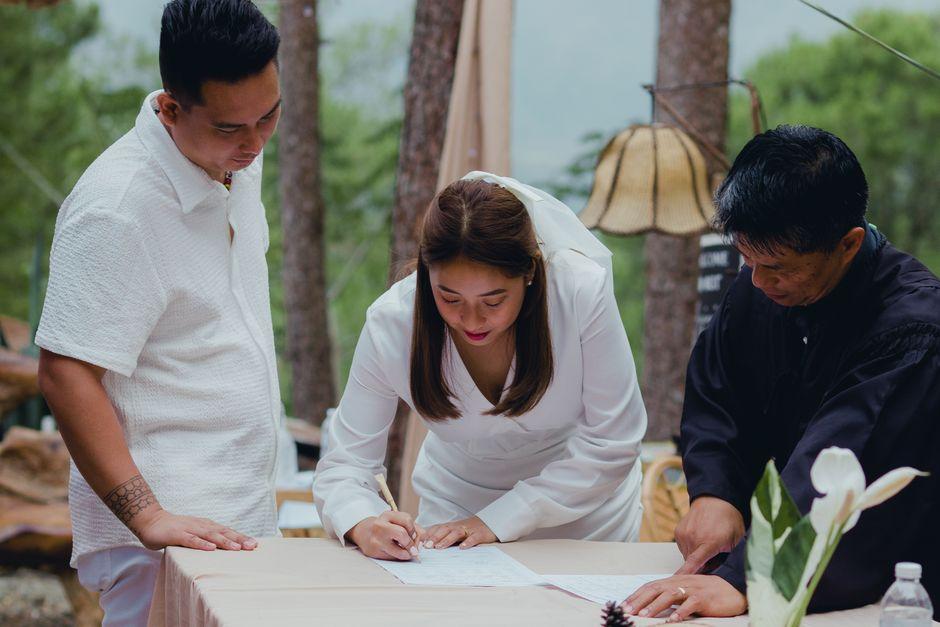
The license and certificate travel with you to the ceremony, where they are signed. The person who performed the ceremony then files them with the registrar of the municipality where the ceremony took place, which may not be the town that issued the license. The state warns that an unfiled certificate causes real trouble later, so follow up to make sure it was recorded. Certified copies come from that town's registrar or the State Office of Vital Statistics and Registry.
With the paperwork planned, see New Jersey wedding venue types by region and our guide to Jersey Shore weddings.
This is a plain-language summary, not legal advice. Laws and local procedures change, so confirm current requirements with your local registrar before your wedding.